



Governance in Facilities Management

And Its Role in a
System of Decisions

What is governance in facilities management?

Governance in facilities management is the system that ensures operational decisions are made consistently, guided by policy, and traceable to outcomes across assets, sites, and teams.

It is not a reporting function. It is not a compliance checklist. Governance is the operating logic that determines how decisions are made at the point they occur, not reviewed after the fact.

Consistent

Similar decisions follow the same logic across assets, sites, and teams

Traceable

Every decision remains connected to the data that justified it

Provable

Performance can be proven to boards, clients, and regulators, not assumed
Why decision-making, not data, is the real gap

Most FM operations look like they have a
data problem. They don’t.

Data exists. Systems record it. Reports get generated. But the decisions that actually determine performance, whether an asset failure is caught early, whether maintenance is prioritised correctly, whether risk is reduced or simply deferred  happen inconsistently.

They depend on who is available, what they notice, and how they interpret the situation at that moment.There is no structure ensuring the same type of decision is made the same way twice.

That is not a data gap. 
It is a decision-making gap.

Governance is what closes this gap  by ensuring decisions are made consistently, within defined rules, and with accountability built in.
What is a System of Decisions and where does governance fit?

These are not separate ideas.
They are part of the same operating model.

The System of Decisions is the environment where decisions happen. It connects data from systems such as CMMS, CAFM, IWMS, BMS, and ERP into a unified operational layer where decisions can be made with full context.

Governance operates within that environment. It determines how decisions are made, what rules they follow, and how accountability is created. The simplest way to hold both is this:

A System of Decisions enables decisions to happen.
Governance ensures those decisions are consistent, policy-aligned, and traceable.

System of Decisions
  • The architecture that brings together FM data and context
  • Enables decisions using connected data from across systems
  • Decisions happen — but inconsistently
Governance
  • The operating logic that defines how decisions are made
  • Ensures decisions are consistent, policy-aligned, and accountable
  • Rules exist — but cannot be applied consistently or at scale
A system without governance lacks consistency. Governance without a system lacks context. Together, they make decision-making structured and reliable.

How governance operates
within decision-making

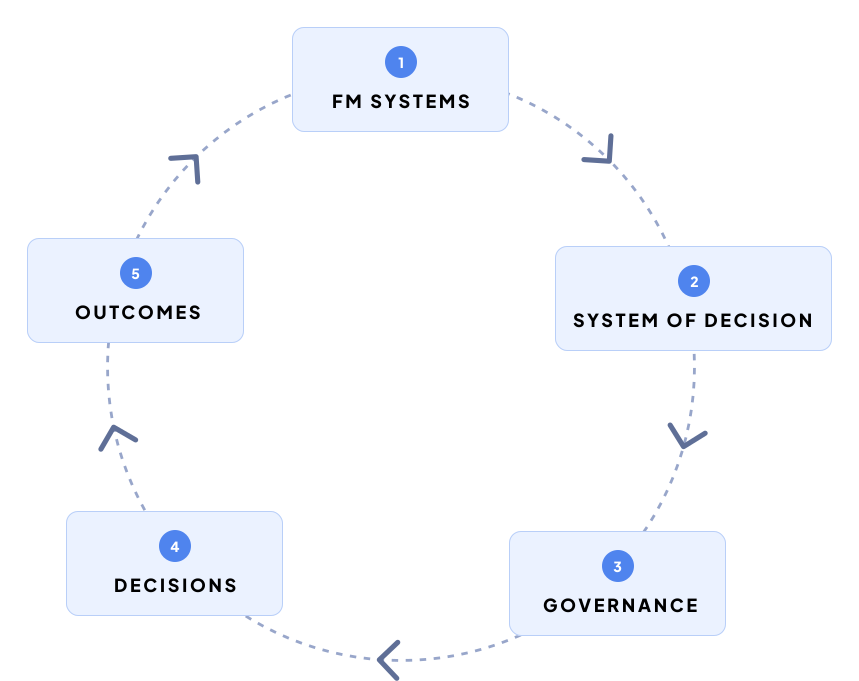
Governance operates at the point where data becomes a decision.
As information flows from FM systems into the decision-making environment, governance applies structure evaluating inputs, enforcing policy, and recording the rationale behind each decision.
How governance operates
This is how fragmented operational data becomes consistent, accountable decision-making.

What governance actually
enforces in FM

Consistency

Similar decisions follow the same logic across assets, sites, and teams. Variation is visible, not hidden.

Policy Alignment

Decisions are evaluated against SLA requirements, safety obligations, and cost thresholds at the moment they are made, not checked manually afterward.

Evidence Linkage

Every decision remains connected to the data that justified it. When a question arises, the answer exists in the record, not in someone's memory.

Risk Visibility

Exposure is surfaced clearly across assets and portfolios, not inferred after failures occur.

Risk Prioritisation

Risk is ranked by probability and downstream impact, ensuring the most critical exposures are addressed first.

Auditability

Outcomes can be verified. Decisions can be traced. Performance can be proven to boards, clients, and regulators, not assumed.

Governance by Effort
vs Governance by Design

The difference becomes most visible in how governance is created.

In most organisations today, governance is achieved through effort — manual processes layered on top of operations. In a governed System of Decisions, governance is built directly into how decisions are made.

Governance by Effort (Current State)

  • Manual: Accountability is created after the fact through reports, reviews, and reconciliation.
  • Retrospective: Issues are identified after execution, during audits or performance reviews.
  • Fragmented: Decision logic varies across individuals, teams, and sites, often relying on experience rather than structure.
  • Implicit: Trade-offs and reasoning behind decisions are rarely captured or standardised.
  • Defensive: Teams must reconstruct and justify decisions when questioned.

Governance by Design (Structured Decision-Making)

  • Embedded: Accountability is created at the point of decision, as a natural outcome of how decisions are made.
  • Real-time: Decisions are evaluated against policy before execution, not reviewed afterward.
  • Consistent: Decision logic is defined and applied uniformly across assets, sites, and teams.
  • Explicit: Every decision is made within a defined framework, with clear rationale and comparable outcomes.
  • Defensible: Every decision is already supported by an evidence-linked record.
This shift — from governance by effort to governance by design is what enables facilities management to move from reactive execution to structured, accountable operations.

The question
Governance answers

The System of Decisions answers : what is happening across our FM estate?

Governance answers: are we operating the way we are supposed to  and can we prove it?

The first is a question of visibility. The second is a question of accountability.

In most organisations, accountability is created manually — through reports, reviews, and interpretation.That is governance by effort.

What Xempla enables is governance by design.

How Xempla implements
Governance by Design

Xempla operates as the governance layer within the System of Decisions.

It sits above existing systems — CMMS, CAFM, IWMS, BMS, and ERP, without replacing them, and uses their data to structure how decisions are made.

Instead of enforcing governance through manual processes, it embeds it directly into decision-making.
Existing Systems
CMMS · CAFM · IWMS · BMS · ERP
backicon
Xempla Governance Layer
Governance embedded at point of decision
backicon
Accountable Outcomes
Consistent · Traceable · Provable
Decisions are structured as they happen, rather than reconstructed afterward. Policy is applied in real time, rather than checked post-execution. Outcomes remain linked to the decisions that produced them, creating a continuous record of accountability.

The result is not just more efficient operations, but operations that can be consistently explained, compared, and proven.

Why this matters now

Facilities management has long been treated as a cost centre, not because of lack of capability, but because of lack of provability.

The challenge has been demonstrating, in a form that stakeholders can trust, that operations are being run consistently and effectively.

Governance creates that capability.

A governed System of Decisions ensures that every output can be traced to its inputs, every claim can be backed by evidence, and every outcome can be explained through the decisions that produced it.
This is what makes FM legible, not just operationally effective, but provably so.
Trusted by
Sodexo-Xempla-partnerRamsay-health-care-Xempla-partnerSila-Xempla-partnerEnergy-australia-Xempla-partnerEmaar-Xempla-partnerPrimustech-Xempla-partner
Sodexo-Xempla-partnerramsay-Xempla-partnerSila-Xempla-partnerEnergy-australia-Xempla-partnerEmaar-Xempla-partnerPrimustech-Xempla-partner

See governed decision-making
in your operations

Understand how your decisions would run with governance in place using the systems and data you already have. No rip and replace. No disruption.

FAQs

What is governance in facilities management?
Governance in facilities management is the system that ensures operational decisions are made consistently, guided by policy, and traceable to outcomes across assets, sites, and teams.
How is governance different from compliance in FM?
Governance in facilities management defines how decisions are made, while compliance ensures those decisions meet predefined rules, regulations, and contractual obligations.
Why is governance critical in facilities management?
Governance is critical in facilities management because operational decisions directly impact asset performance, cost, risk, and compliance, yet are often made inconsistently without a structured framework.
How does governance reduce reactive maintenance in FM?
Governance reduces reactive maintenance by ensuring decisions are made using consistent logic, real-time data, and policy constraints, allowing issues to be prioritised and addressed before they escalate into failures.
How do you measure governance effectiveness in FM?
Governance effectiveness in facilities management is measured by how consistently decisions are made, how well they align with policy, and how clearly outcomes can be traced back to those decisions.
How is governance related to a System of Decisions in FM?
In facilities management, a System of Decisions brings together data and context for decisions, while governance defines how those decisions are structured, evaluated, and controlled.
Can governance exist without a System of Decisions?
No. Governance cannot operate effectively in facilities management without a System of Decisions, as it requires connected data and context to be applied consistently and at scale.